Sunday, September 18, 2011

The Ghengis Khan-Khan: How we hitchhiked and slept in a stranger's tent house all without dying!

The first leg of our Trans-Siberian journey was an overnight train from Beijing to Ulaanbaatar. The train was clean and modern (we even had a power outlet in our room!) and the top bunks never filled up so we had the whole cabin to ourselves. The only exhausting part of the journey was the extremely long stop at the border. China's tracks are a different gauge than those of Mongolia, so we didn't get to sleep until around 2 am after waiting for the wheels to change (in addition to the usual tedious immigration procedures).
trans-siberian cabin

Arriving in Ulaanbaatar, our initial impression was that it was freezing. We had only long underwear and sweatshirts for warmth because we weren't expecting 36*F temperatures in September, but apparently that's the norm. The city basically has one main road that everything interesting is either on or next to, so traffic on this road is some of the slowest moving I've ever seen.

Mongolia is famously unfriendly to vegetarians, but vegetarian restaurants have become surprisingly trendy in the capital city. There were five Loving Huts alone!

On our second day, we decided to head to Gorki-Terelj National park, just a two hour bus ride from Ulaanbaatar. We hadn't realized the public bus would be filled to the brim for most of the journey, and Greg spent the whole ride leaning on an armrest. The description of the park we got online told us that there are tourist ger (Mongolian nomadic tent house) camps leading up to the town of Terelj. What we didn't realize was that our bus went the opposite direction, starting in Terelj and going through the park before heading back to the city. So basically we missed our stop. Alarmed, we decided to get off at what we thought might be a tourist camp. It was not. This was where we started to panic, remembering that there's only one bus a day.

It was just moments later that we noticed somebody else, a Mongolian woman in a traditional outfit, had also exited the bus. She must have observed our panicked looks because she quickly waved us over to follow her. We descend a hill and go through some trees before arriving at her family compound, all the while shooting each other looks of "what the heck are we doing?" Our Mongolian is as good as her English, which is to say we have no way of communicating. We pass a small house and some horses before arriving at a ger. She shoos out two people who I think are her daughter and her daughter's boyfriend before waving us in and pointing at the beds. We shrug and hand her some cash for her hospitality.
ger interior

As we get settled in our toasty little tent and figure out how to load the stove, we marvel at how weird this whole situation is. Then there's a knock at the door. The daughter is there.

"日本語わかりますか?”("Do you understand Japanese?") she asks.
Without much thinking I reply in the affirmative. She explains that she forgot her mirror and we invite her in. It isn't until she leaves that we realize how much weirder this whole situation just got. Not only does this girl in the middle of nowhere in Mongolia speak Japanese, but she happened to find probably the only two white people for several thousand miles who also know Japanese. How in the world did she know to ask?

It soon got dark and there wasn't much to do. Luckily we brought entertainment. Yes, we watched Bill and Ted's Excellent Adventure on my laptop in a ger in Mongolia. Because, y'know, like, Ghengis Khan's in it so it was, like, totally relevant.
our ger

The next day we thanked our host and hiked back up to the road to catch the bus back to town. Greg became fast friends with some of the local dogs along the way. Our bus passed through some gorgeous rock and tree filled sections of the park, but unfortunately we couldn't get any pictures.
Surrealistic rocks in Terelj NP Mongolia
Thanks to the internet, it's ok that I didn't get any photos of my own!

Back in town, we checked into a hostel. We had a personal guided tour through the intellectual museum, which was basically just one wacky guy's display of puzzles he's made and various toys he has collected. When it was time to head back to the train station we decided we didn't want to walk because we had built up a huge collection of food in preparation for several days on the Trans-Siberian railway. There seemed to be no taxis, but one of the hostel employees explained that if you stick your hand out someone will give you a ride. It worked! Surprisingly quickly, too. Two women pulled over and we told them "train station" and then they spent the remainder of the ride completely ignoring our presence. We gave them our leftover Mongolian money we hadn't been able to convert to rubles, and they seemed more than pleased with the amount even though it was less than five dollars.
mongolian hills

Now I'm typing this on the train to Moscow, which will involve four long, shower-less nights of traveling and eating instant noodles. It's the low season, so most people on the train seem to be Mongolian merchants who get out at each stop to sell cheap track suits to immense hordes of Russian shoppers who apparently gather at the stations just to shop.

Competition for the few working power outlets in here is fierce, so I don't think I can keep a daily log of our cabin fever. I'll just type what a think will happen after my battery dies:

Andrea's Log, Day 5: The weather is nice. I have made a necklace out of Greg's intestines.

Saturday, September 17, 2011

China

The Vietnam/China border proved less intimidating than some of our guidebooks had promised. Our train dropped us off at 4 in the morning, so we sat outside on the steps of the Vietnamese customs building until it opened at 7. We heard stories of Chinese border guards rifling through your bags in search of (among other things) travel books whose maps dare to color Taiwan differently from the mainland. Happily, we didn't experience anything like that; one of the guards was even pretty friendly and tried to help us fill out our entry form.

After crossing a weird no-man's-land bridge over a river and passing through customs, your entry point in China is Hekou, which was pretty squalid, albeit more developed than the Vietnamese town across the river. We had a hard time changing our money at banks because it was a Sunday; a helpful young policeman tried to find us a working ATM while practicing his broken English on me, but we were unsuccessful-- you could tell he was pretty bored and was mostly just looking for an excuse to get out of the office.

Finally, we found a guy at the bus station who was not only pretty fluent in English, but was also willing to change our money at what was a decent rate considering he was the only game in town that day. We boarded the bus bound for Kunming, and proceeded to experience 10 hours of driving through some pretty incredible scenery: elevated freeways through steep mountains, supported by impossibly tall columns and winding through endless tunnels. As we got approached Kunming, we came across some bizarre, unearthly rock formations and rows of spherical trees unlike anything I've seen before. It felt like we'd entered another planet after the endless jungles and hills in Vietnam and Cambodia. We later realized that what we were looking at was Kunming's star tourist attraction, the Stone Forest National Park.

Apart from that, Kunming doesn't have much to offer tourists, but the city was pretty incredible to us at the time. I'd never even heard of the place before we started planning the trip, but with a population of 6 million, it was much bigger than any other place we'd been to up to that point. The high elevation and dry climate allowed for mid-August temperatures in the 60s and 70s, a welcome relief from the nonstop sticky heat up until then.

The city center was mostly very clean and modern-- so much so that we almost felt like we were back in Japan. There were lots of genuine high-end retail shops, and a few convincing fake ones, too. We saw two of those imitation Apple stores that have been getting some attention in the West -- I presume they were both just different enough to avoid getting shut down.

Very soon, we discovered a very different language barrier than what we'd experienced before. Vietnamese and Cambodians almost always knew a little English (i.e., just enough to get you to buy something), but the Chinese we dealt with either could speak very well or knew none at all. Having learned some Japanese in our two years living in Kanazawa, we were in the unusual-for-Western-tourists position of being able to read and write some Chinese while having zero listening or speaking ability. This proved very helpful at many points where we could have easily gotten lost, and allowed us to try things we might not have otherwise tried, but the differences between the languages sometimes made for some confusion and frustration.

Our next stop was Chengdu, and our plans to take a sleeper train out of Kunming were foiled by the mad rush of high tourist season. Our knowledge of Chinese characters allowed us to figure out that all train seats on the route we wanted were completely booked for the next 10 days. We ended up finding a company that sold us tickets for a sleeper bus, which did allow us to lay down for the night, but it was cramped, stuffy, and didn't allow you to wear your shoes anywhere inside, even on the floor of the urine-soaked squatter toilet.

Finally in Chengdu, we found another modern, relatively clean city, with hotter temperatures than Kunming, but also with a fantastic subway line that had just opened a year earlier, which clearly had borrowed liberally from the design of Singapore's own modern, efficient metro system. Chengdu is the largest city in Sichuan (also romanized as Szechuan) province; if you've heard of or tried this ultra-spicy brand of southern Chinese cuisine, this province and its capital city are the epicenter.


First up on our tourism docket was the Leshan Grand Buddha, the largest carved stone Buddha statue in the world, and, completed in 810 AD, the largest pre-modern statue in the world. With the help of a nice college student who was majoring in English at Chengdu University and happened to be returning home to Leshan on the same bus we were taking, we made it there and back entirely on public transit.


The Grand Buddha is probably the only tourist site on our trip so far that was actually bigger than I had anticipated. It was carved into the side of a mountain at the banks of a river, and required a pretty steep hike down and up to get down to the Buddha's feet, where we took the requisite pictures alongside to give an idea of the full scale of the thing.


Our other big stop in Chengdu was the Panda Research Center, where we met a fellow American, a Vermonter named Alex who is living in China and speaks the language pretty well, much to our benefit. The center had 4 or 5 red pandas, who were playing and scurrying outside, and perhaps a dozen Giant pandas, who dislike the heat so much that they prefer to laze about in the cramped (but air-conditioned) indoors in the summer, despite the enormous outdoor enclosures they had access to.


The most memorable sight was the dozen or so baby pandas, all born in the past three weeks, who were being kept in incubators to ensure their survival in the tough early months. We weren't allowed to take pictures of these guys, and it's just as well, because as infants they resemble shaved molerats and had a few more months before they grew enough hair to become recognizably panda-like.


After Chengdu, we were stuck with another bus ride to Xian, during which a very stern lady attendant vigorously enforced the no-smoking policy with what amounted to a public shaming (which didn't stop the same guy from trying to light up two more times during the night, each time resulting in the lights being turned on and a few more minutes of arguing). Xian was a lot more like the China I was originally expecting-- hot, loud, dirty, congested, and (less expected) unrelentingly dusty, so much so that we came back caked in a layer of dust every time we ventured outside our hostel.


Xian was our base point for seeing the Terracotta Army. Our experience there was a little anticlimactic; not knowing any better, we first entered the first of three buildings, which contained the iconic pits with hundreds of warriors lined up. It was pretty big, but nowhere near what we'd imagined, so we figured the other two buildings had something more impressive. Wrong! Those were mostly just huge empty pits they'd already removed the soldiers from. Apparently the excavation is ongoing-- check back in a few years and they'll have a lot more soldiers lined up.


We were finally able to secure a sleeper train for our trip to Beijing, but it required us to spend three extra nights in Xian, whose dirt, heat, and grime started to wear out their welcome. Our 100+ year old hostel was nice enough, but apart from a dollar store with some hilarious knock-off products ("Horseman" razors, modeled after Gillette, and not Crest, but "Craot" toothpaste), Xian didn't have much going for it besides terrible air quality, horribly congested traffic, and a still-incomplete subway that was months away from being usable.

Finally, we got on the nicest non-Japanese train we'd ridden thus far, and arrived the next morning in Beijing, a city whose municipality is roughly the size of Belgium, and as such would be underserved by the descriptor "sprawling". The city center is served by an excellent (if at times inconveniently located) subway system that connected our hostel's area, a cute neighborhood centered around a large Buddhist temple, and the city's main shopping and business districts.


Our first full day was spent on a Great Wall excursion. The section we went to was slightly less packed with tourists and vendors than the famed section that Nixon (among others) had been photographed at. It did, however, boast a ski-style chairlift up to the steep mountaintop where the wall was located, and an exceedingly fun slide down the hill, where you pilot a little plastic seat with wheels and a single lever that functioned as both brake and accelerator.


Our other big Beijing stop was Tiananmen Square, where a random Chinese guy insisted on taking his picture with us, solely because we were white people in China, and the Forbidden City, which was more impressive for its size and scope than the repetitive architecture.


I can't speak for Andrea, but overall I left China with a much more positive impression than I was expecting to. The people and places were enjoyable more often than not, and much of the scenery we passed by was breathtaking. The government, on the other hand, was the source of some headaches, primarily in the form of the random bus inspections by the police and the (evadable) Internet censorship. Still, we were mostly left alone. Based on what I saw, I assume it's because the cops couldn't speak English and didn't want the hassle of dealing with us; the locals probably get it a lot worse than we did. The police intrusions got less and less frequent as we traveled further north, as well.

We rose early on our last morning in Beijing. After a brief subway ride, we arrived at the train station and boarded a train bound for Ulaanbataar, Mongolia, beginning the overnight climb into the desert steppes...

Thursday, August 25, 2011

Hoi An and Hanoi

After the modern excitement of Ho Chi Minh City, we caught the overnight train to Da Nang so we could enjoy the seaside. The coast was littered with condo and resort developments. It was often difficult to determine whether they were still under construction or already abandoned. We stayed in Hoi An, a historic port town with a nice beach. We used the hotel's free bikes to get to said beach. We happened to pass a vegan restaurant a woman was running out of her garage. It was buffet style and quite tasty. We also explored the old town area, which is very touristy but quiet and nicely preserved.

riverside houses

For dinner we walked a ways out to a very local vegetarian restaurant. They had a veganized version of the town's famous dish, a noodle bowl with various "pig" parts that uses special lye containing well water. It was delicious! They also had an amazing array of pre-packaged vegetarian faux meat including pig's ears and snails.

We took another overnight train up to Hanoi. By the time we got there we were quite exhausted. We were expecting the same shocking modernity as we found in Ho Chi Minh City, but Hanoi is still a bit more old fashioned. It's nearly impossible to find a cab that'll go by the meter, so you're forced to haggle for fares - a difficult task when you don't know the true distance. Our hotel was called the "Moonshine Palace." I don't think anyone's told them what moonshine means, at least to Americans. Initially, they put us in a top floor room. Then the rain started coming down fast, and it was falling equally fast through cracks in the ceilings! We showed them the inch of water pooling on the floor and they upgraded us to the "deluxe" room for free.

The problem with having to constantly haggle with people and the rising feeling you're constantly being scammed is that you occasionally end up being stand-offish or rude to the people who are actually being helpful. We went to the bus terminal to get a ride to Cuc Phuong national park and were immediately approached by a crowd of young men trying to sell us bus tickets. We assumed it was a scam, so we went straight to the ticket window. The woman wouldn't sell us a ticket and we couldn't figure out why. Eventually an English speaking woman came out from the back and said we should sit and someone would come sell us a ticket. We did as we were told, but we were still being repeatedly approached by the men we assumed were scammers. Eventually we figured out where the bus was and got on. Then one of the "scammers" got on and charged us the same standard fare as the locals. He ended up being pretty friendly even though we had basically blown him off a bunch of times in the station. As far as I can tell the buses are privately run but the station creates a standard fare, so the companies compete to get more customers.

When we arrived at the station it was time to have yet another adventure in haggling. I thought I had read that a motorbike ride from the station to the park was only 20,000 Vietnamese dong per person. It was pouring so we wanted a taxi. A guy told us he'd take us there for 300,000, which I said was ridiculous. He would only budge to 250,000, which we thought was still a major rip off. We finally give in, but instead of taking us to a cab he sits us down at his shop and he lights up a bong. He offered us some and I can only imagine what kind of scam he runs on tourists that agree. We're there fuming about having to wait for a cab we're overpaying for when we spot a real cab. Of course our "friend" angrily follows us and tells the cab to not take any less than 250,000. We demand 200,000. After much arguing we decide we'll just walk into town and have lunch. When we finally get away from our "friend" the cab drives up and says he'll do it for 200,000. The hilarious thing was that the park station then told us that 250,000 was pretty much the standard fare. It was the first and only time we managed to haggle in our favor, and it was a total accident!

At Cuc Phuong park we rented a lakeside bungalow and spent an energetic evening chasing mosquitos before finding the provided mosquito net. In southern Vietnam and Cambodia it typically only rained for three hours a day, but in the north it seems to rain all day and night and you get about three hours without it. This prevented us from really exploring the park, but we did enjoy the primate rehabilitation center, where we watched langurs and gibbons swing about and make some amazing loud noises. We also completed the steep and extremely slippery hike to the observation tower.

view from observation tower at cuc phuong


Vietnamese drivers are generally pretty crazy, but the one who took us back to the bus station should win some sort of prize. His method was to push the accelerator all the way down while continuously blaring his horn so that other drivers would get out of his way. He didn't understand that chickens don't know what a horn is, so we had a few near misses. At one point we came upon a man crouched in the middle of the road and our driver actually sped up. His only English was "only in Vietnam!" which he repeated gleefully every time he nearly pushed a scooter or cow off the road. He played us a bizarre radio program intended to teach Vietnamese children English using nursery rhymes. In one of the more surreal moments of my life, he swerved around a herd of cattle while we listened to girls with "The Shining" twins-like voices sing "Jack and Jill". Back in Hanoi, we actually had a hard time figuring out what to do. An incorrectly labeled Google Map prevented us from visiting the Ho Chi Minh mausoleum and seeing his actual body (which is only available in the morning). We did see the Ho Chi Minh Museum, which was rather odd. It has a lot of bizarre sculptures and cars crashing through walls that are supposed to represent Ho Chi Minh's ideas. Then it was an excellent dinner by the train station, and a train ride to the Chinese border.

Monday, August 22, 2011

Saigon. Shit.* *(not actually shit)

We came into Vietnam with a little trepidation. Our friendly guesthouse proprietor in Phnom Penh had warned us that the Vietnamese tend to view outsiders solely as potential money sources ("wallets with legs" was the phrase he used). We weren't exactly sure what to expect when we got off the bus at Ho Chi Minh City (formerly Saigon-- the two names are still used interchangeably), but we were pretty surprised to find a modern but still-growing big city that wasn't all that different from Bangkok or Taipei. Compared to even the most developed parts of Cambodia, it was light years ahead in terms of infrastructure and amenities.

Not sure how to find our hotel, we asked a bank security guard for directions. He wasn't much help, but a passing guy on the street who spoke some English offered to show us the way. Turns out it was just around a corner and down an alley. Not only did he lead us straight to the hotel, he didn't even ask for anything in return. We didn't completely let our guard down, but it was kind of a relief to know that not everyone was going to take advantage of the disoriented tourists.


While HCM has more traffic lights with crosswalks than Phnom Penh, many crossings are of the uncontrolled, endless stream of motorbikes and cars variety. There is something of a method to the madness-- scooter drivers are surprisingly adept at weaving around pedestrians, which means you can (and pretty much have to) walk right out in front of oncoming traffic with some confidence that you won't end up in a neck brace afterward.


After getting settled, we set out for our first day of sightseeing. First up was the Reunification Palace, which was the official residence of the president of South Vietnam prior to the fall of Saigon. The building was of a neat mid-century-meets-traditional-Asian design, if a bit empty, but you did get to see things like the actual furniture, maps, and radio equipment they used during the war. There was also a pretty swanky roof patio, and a slightly creepy, labyrinthine basement that featured a lot of empty desks with decades-unused phones and radio equipment on them.


This was followed up by the nearby War Remnants museum, which featured some leftover American jets, helicopters and tanks on the outside, and some awful, depressing (if excessively slanted toward the North) pictures of the human effects of the war on the inside, including a wing specifically dedicated to picture of birth defects caused by Agent Orange, and glowing tributes to Americans and others who self-immolated in protest of US military involvement in the region. The most interesting part was an authentic reproduction of the brick prison cells and tiny barbed-wire cages that the South used to contain Northern POWs, which offered a mirror image to the infamous Hanoi Hilton torture techniques of the North.

After that fun bit of business, we checked out Ben Thanh market, which apart from some decent hand-painted reproductions of Tintin comic book covers, offered nothing but the same old parade of tacky t-shirts, handbags, and other tourist junk. That night, we enjoyed a fantastic meal at Saigon Vegan, which was one of several restaurants that catered to our diet in the city.


The next day, we took a long trek on a near-empty public bus to Suoi Tien theme park, which I think is one of the most bizarre places I've ever been to in my life. It's got standard theme park stuff-- roller coasters, laser tag, little kiddie rides, a water park with slides-- but everything is Buddhist themed, which came in the form of numerous shrines, giant statues depicting legendary creatures, and groups of visiting monks who apparently like to take in a roller coaster and snow cones from time to time. 


And did I mention the crocodile park? One of the big-ticket items at Suoi Tien was an elevated walkway above a pond with at least a hundred of those things staring out with their beady, dead eyes, in each tiny brain solely a lament of the existence of the metal barrier between it and the gawking meatbags taking photos from above. For a fee, you can tempt fate and feed them hunks of meat from a fishing pole. We declined, but watched a few others go for it. I couldn't tell you what's more terrifying-- the slow, mindlessly deliberate opening of the jaws when it sees a piece of meat in front of its face, or the deafening, heart-attack-inducing THUNK of the jaws suddenly closing at a million miles an hour.


Leaving our reptile friends behind, we continued to one of the more interesting attractions at the park, called the Citadel. You cross a bridge to a building in the middle of a man-made lake, where you proceed to take a creaky old elevator down, leading into a pitch black hallway with faintly glowing arrows on the floor. Having gone in with no idea what it was supposed to be, we quickly realized it was some kind of odd haunted house, with a shaking floor, some crude animatronic monsters and gruesome still displays, and (best of all!) some guy who grabs at your ankles from a hidden booth underneath the floor. Can you imagine having that job-- waiting in a pitch black room in the middle of a pond just for some confused people to wander in so you can grab their ankles and freak them out? 


Shortly before we decided to leave, while eating some much-needed fruit chip snacks before the long ride back to the city, this adorable, smiling old Vietnamese lady comes up to us out of nowhere. She must have assumed we were French, because she told me "Bon voyage, et a vos santes"--  have a good trip, and to your health-- which was by far the most use I've gotten from my four years of high-school French in a long time, as well as an unexpectedly warm and genuine gesture.

The next day, after a couple of rounds of bowling on the fourth floor of a trendy shopping mall just to kill some time, we boarded our sleeper train headed for Da Nang. We shared a room with a nice older Australian couple, who expressed relief that they wouldn't have someone noisy who they couldn't understand, but seemed understandably wary of the 30+ hour journey ahead of them, as they intended to continue all the way to Hanoi after we got off. I drifted off to sleep a few hours later. 

And that was our Ho Chi Minh City experience! Andrea will pick things up from here with our (mis)adventures in Hoi An and Hanoi.

Saturday, August 13, 2011

Battambang and Siem Reap

From Phnom Penh we traveled by bus for six hours to Battambang, Cambodia's second largest city (that doesn't seem especially large at all).

Our first stop was an exciting ride on the bamboo train. The French built a train line through town ages ago, but it has since stopped running. Ingenious locals haven't let this prevent them from traveling by rail. They take a pair of axels and place them on the tracks. Next, a wood platform goes on top of the wheels. The final ingredient is a small engine. The resulting ride on the in need of repair tracks is not unlike going on a seatbelt-less, flat roller coaster. There's only one set of tracks, so if you meet up with another train you have to unload, disassemble the cart, and let the other group pass.


Our friendly tuk tuk driver next took us to see a popular bat nesting spot. It's near a Buddhist temple, so the bats are protected from slingshots.

battambang bat


Wat BananWe then hiked up the seemingly endless stairs to Wat Banan. Our driver gave us a tour of a nearby cave, which was also full of bats. He also bumped into a police officer who grew up in the same orphanage as he did and they had a chat about their childhoods. After that, he spotted some Cambodian milk fruit in a tree and he climbed it to fetch some for us. It wasn't quite ripe, though, so it had a weird, sticky after taste. Our last stop was the Killing Cave. We were feeling lazy after the hike to Wat Banan, so we took up the offer of a couple of local boys to cart us up the mountain on their motorbikes and give us a tour.

killing cave

The Khmer Rouge threw 10,000 prisoners down this hole into what was then a closed off cave. If the prisoner was lucky, he died immediately. If not, he probably suffered for weeks with broken bones surrounded by decaying bodies before finally starving to death. There are cases of bones within the cave, but I didn't feel comfortable photographing them. That's been a strange part of being a visitor in Cambodia. A lot of the tourism here revolves around the shocking actions of the Khmer Rouge, and it's a bit unsettling to have young drivers and guides gleefully inquire "You want to see killing fields?"

riverside house

The next day we were somehow convinced to take the "scenic route" to Siem Reap. It was a pricey, slow, uncomfortable boat ride that had pretty scenery that became increasingly difficult to enjoy as more and more parts of the boat broke down and more and more tree branches smacked me in the face. After eight hours we finally made it and took a tuk tuk to our hotel.

Siem Reap is much more touristy than Battambang, due to its status as the gateway city to Angkor Wat. On our first day we completed the "Grand Tour" of Angkor, visiting the outer temples by tuk tuk. We finished the day at Angkor Thom, which ended up being my favorite Angkor temple. Built in the late 12th century, the temple has more than 200 giant faces carved in its stone.

Bayor, Angkor Wat

The next day, we decided to take a break and relax in town. We ended up at Chamkar vegetarian restaurant, where we had the best meal of the trip, if not my life. The French chef operated restaurant is pricey by Cambodian standards (a whole $5 a plate!) but worth every penny.

photo.JPG

The following day we rented some cheap bikes from a charity organization and peddled from town back to Angkor Wat. This time we completed the small loop, which is about 20km. It included Ta Phrom, where tourists like to stand in line for 20 minutes to get their picture taken in the "Tomb Raider" doorway. The funny thing is that there's a similar doorway at a much less crowded temple down the road.

door trapped in a tree

Me, drenched, with my Angkor chariotThen, unfortunately, came the rain. In days past the rain hadn't started until 3 o'clock so we had planned to be back in town long before then. Just our luck, the rain came down at 11:30, and it came down hard. We ended up peddling from overhang to overhang trying to wait it out because our ponchos weren't doing much good. Eventually we decided to head out anytime the rain downgraded from torrential to simply pouring. Thankfully, it started to clear up about the time we arrived at the main Angkor Wat temple. Scaffolding prevented us from getting any decent shots of the famous approach to the temple, but the overall scale and grandeur didn't fail to impress.

Greg at Angkor Wat

Wednesday, August 10, 2011

Phnom Penh reflections

After a lengthy flight route that involved three plane rides, three security lines and four(!) customs checkpoints, we made it, bleary-eyed but intact, to Phnom Penh International Airport. Whereas Bangkok's airport tries a little too hard to impress you with its modern design and grand scale, Phnom Penh is decidedly more modest. Soon after getting off the plane, they dump you at the customs counter, where most tourists, us included, have to fill out a form and pay $20 US for a visa to enter the country.

That's another thing. Cambodia has its own currency, the riel, but the de facto standard is the US dollar. The riel is pegged to about 4000 to 1 USD, so the result is an odd hybrid of a monetary system that uses American bills like normal, but eschews American coins in favor of riel bills. It's common here to pay for most things with US dollars, and receive your change back in riel. Once you get used to making the conversions in your head, it's easy to grasp, but the wide array of riel bills that don't have a direct US coin equivalent can be confusing.


As one might expect from Cambodia's largest city and political/economic hub, Phnom Penh is a lively, colorful city full of street vendors, food carts, precarious-looking construction sites, and (an inevitability in Southeast Asia) an endless stream of motorbikes and cheap taxis geared toward tourists called tuk-tuks streaming through cross-traffic at uncontrolled intersections. If you're walking around here and look obviously foreign, expect to be solicited for a tuk-tuk ride in broken English approximately every 15 seconds. As cheap as they can be, this city's sights are in a compact enough area that you can probably see everything on foot in 1 or 2 days if you're feeling up to it.


That's essentially what we did. We followed a Lonely Planet suggested walking tour, which was alright for a quick overview of the city center. Still, apart from the King's palace and adjacent museum, there isn't a whole lot in terms of obvious sightseeing that this city offers. The most impressive, or maybe imposing, sight we encountered was actually the American embassy, which was a wide, recently constructed building behind tall metal gates and guarded by bored-looking men who enforce the no photos policy. Also on the compound was a modern playground, presumably for diplomats' kids with nothing else to do.


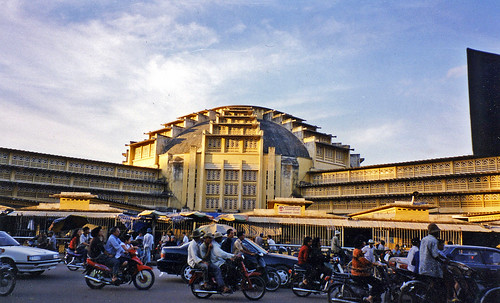
Next up on our tour was the old central market, which was housed in a beautiful, distinctive dome that looks nothing like any other building in this country that I've personally seen (and anywhere else, really). Unfortunately, the hundreds of vendors it houses have only the standard knockoff jeans, shoes, bags, electronics, and tacky souvenirs that are stock in trade for these sorts of places. After wandering around there, we found relief from the heat in a fairly modern, seven-story mall that ended up being pretty similar to the old market- rows of stalls with cheap goods, only stacked vertically and air-conditioned. I needed a belt, so I got my haggling feet wet and managed to knock a couple of bucks off what was probably a fairly inflated price to begin with. Tourists can expect to pay a markup for almost everything that isn't clearly labeled.


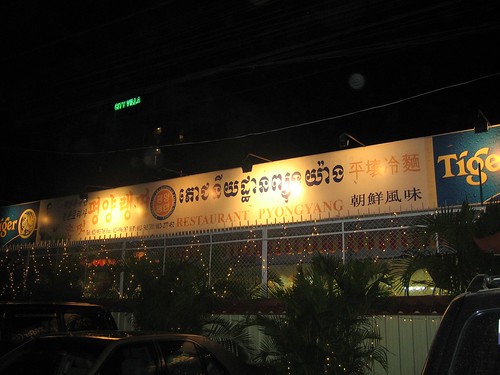
We enjoyed a cheap, filling lunch of curry noodles, fried seaweed, and olive tofu at a nice little vegetarian place called (appropriately enough) The Vegetarian. Across the way was a slightly creepy North Korean restaurant that we were too scared to approach:

Just as well. I've read that these joints exist across East Asia, are administered by the DPRK government, and serve Kim Jong-il's choice delicacies, including, yes, dog meat. Yikes.

After lunch, we found ourselves in a bit of rain. Then a bit more. Then a lot more. Then more rain than I've seen fall at once in my entire life. After a hot, cloudless first few hours, we got soaked head to toe and ran for the nearest tuk-tuk back to our hotel, and watched the crazy flooding that happens in a drain-less city from the safety of our third-floor room.


Our accommodations were at the Europe Guesthouse, a comfortable, centrally located, yet modestly priced place two blocks from the Mekong riverfront. The proprietor is a guy named Seng, a Cambodian who grew up in France after hiding out in the wilderness with his family for two months to hide from the Khmer Rouge. He proved to be incredibly friendly and helpful, setting up our visas for Vietnam, booking our bus ride to Battambang, and arranging for a discount rate at a hotel in Siem Reap. His wife was expecting a baby within a few days of our arrival, so he was in and out after our first couple of encounters.

So, how to sum up this city? It ranges from dirty, smelly, congested and loud to beautiful, energetic and delicious. It makes Bangkok seem tame in comparison, and it's nowhere nearly as tourist-friendly or developed in terms of infrastructure and transportation. Sidewalks, if they exist, are almost entirely taken up by cars, carts, garbage, inexplicable piles of rubble, and anything else you might think of. All in all, it's a little scummy and rough around the edges without being particularly dangerous, if that's your kind of thing.

That said, it's well-traveled and semi-accessible without feeling overcrowded with other backpackers and tour groups-- probably a byproduct of visiting during the rainy season. It's dense and closely knit without being suffocating, compared to, again, Bangkok, which tended to feel either oddly empty and lonely, or overfull with scam artists and entitled Westerners with large suitcases. I wouldn't recommend staying in Phnom Penh more than a few days, but there's still a lot more to offer than what I expected, particularly outside of the usual sightseeing stops.


We'll have more later, including Cambodia's version of high-speed rail in Battambang, and exploring Angkor Wat. In the meantime, we're getting ready to leave for Ho Chi Minh City/Saigon tomorrow morning. Catch you all later...

Wednesday, August 3, 2011

Saying Sayonara

The great around the world trip of 2011 has begun. It's been a rocky start. Did you know that the Japanese postal service refuses to ship laptops internationally? We sure didn't. Did you know that you need your personal stamp to transfer money to an American bank account? We sure didn't. Did you know our flight from Nagoya to Guanzhou, China had a stop in Shanghai? This is yet another of many things we did not know this weekend.

Laputa androidWe spent our final Japanese weekend in Tokyo. It was a mix of fun and last minute errand running. On Saturday we enjoyed an exhibit about animator Frederic Back and not one but two vegetarian Taiwanese meals. On Sunday we hit up the Ghibli animation museum. It's a really wonderful place with lots of fun animation toys to look at. I want to live there. On Monday we visited Nekorobi, a cat cafe in Ikebukuro. Much like our previous cat cafe experience, the cats were a bit on the neurotic side, but this place had a decidedly more relaxed vibe. Plus it had unlimited drinks and cookies. Greg managed to make a friend who was quite demanding of belly rubs. I was satisfied with managing to breathe.

cat and cat toys

Now we're sitting in the airport waiting to board our flight to Cambodia. Hopefully it will be smooth sailing from here on out.

Saturday, June 18, 2011

Japanese sweets: sugary play dough!

Hisashiburi desu ne? (Long time no see, eh?). We're in the final stretch of our Japan stay, and we've been neglecting the blog a bit. So what have we been up to? We took a little trip to Singapore in May. Our adventures consisted mostly of eating excessive amounts of glorious food, sweating, and going to the weirdest statue park I've ever been to. We also went sledding! There was a science museum where you could get a joint ticket to an artificial indoor snow park next door so that after learning about climate change you can make a snowman in a giant freezer box in a country where the temperature is 90 degrees with 100% humidity year round! Also their airport has a three story high slide that was pretty sweet.

We're slowly starting to prepare for our Japanese departure and subsequent adventures. We're saving money for said subsequent adventures, so we're keeping our activities on the cheap side for a while. We did enjoy a Japanese candy making class last weekend.

What they're supposed to look like:

candy samples

What ours looked like:

our candy

Guess I won't quit my day job… Oh wait, I totally am.

Thursday, March 31, 2011

Kanaguya Onsen

Kanaguya Onsen

As radiation continues to not be threatening to most of Japan, we decided not to postpone our spring vacation plans. We headed into the mountains of Nagano (you know, that snowy place with the Olympics) to enjoy a couple of relaxing days in the hot water of Shibu Onsen. We splurged on a fancy ryokan called Kanaguya. It's said that it was one of the inspirations for the animated film Spirited Away. The atmosphere of the place was lovely, mixing large, clean rooms with really old and semi-decaying private hot spring baths. You can wander the labyrinthian hallways and jump in to any tub you like the entire duration of your stay. I especially liked a cave tub that was built into the side of the mountain.

Kanaguya Onsen - dark path

Kanaguya Onsen - foodThey provided us with excessive amounts of food at both dinner and breakfast. What you see in the picture was just the beginning - they brought out several more courses after that.

We took a bus to Jigokudani Park and then hiked along a snow covered path for about a half an hour to visit the famous snow monkeys. These Japanese Macaques are the only non-human primates to live in such a cold environment. They've learned to take advantage of the local hot springs and enjoy a good soak in the tub as much as their human counterparts.

Jigokudani Snow Monkey - scooping water with hand

While taking pictures there a news team showed up and the reporter started chatting up Greg. They were trying to shoot a story about foreign tourists being scared of traveling to Japan because of radiation fears. Greg declined to appear on camera, but that didn't stop the reporter from attempting to jam a mic in Greg's face and point a camera at him anyway. We did only see one other foreigner during our entire trip, so they probably had to wait a while to find another person to talk to.

Jigokudani Snow Monkey - profileThe town of Shibu Onsen was pretty empty and most shops didn't bother to open. We entered one shop so I could buy the requisite souvenirs for my coworkers and the old lady working there was bored enough to give us a personal demonstration of every item in her shop. She added up our total on an abacus despite having a register at hand. She was adorable!

That night we did have a little 4.5 earthquake but it was of the "did a giant truck just drive by?" variety rather than the slow rolling dread of the big quake.

On our final morning we hopped in a tub for one last soak. We opened the windows to watch the snow fall. I saw some mysterious shadows and thought a person was approaching. I stuck my head out to find that a monkey was traversing the pipes feeding water to the building. We declined to let him join us.

Kanaguya Onsen - Snow fall